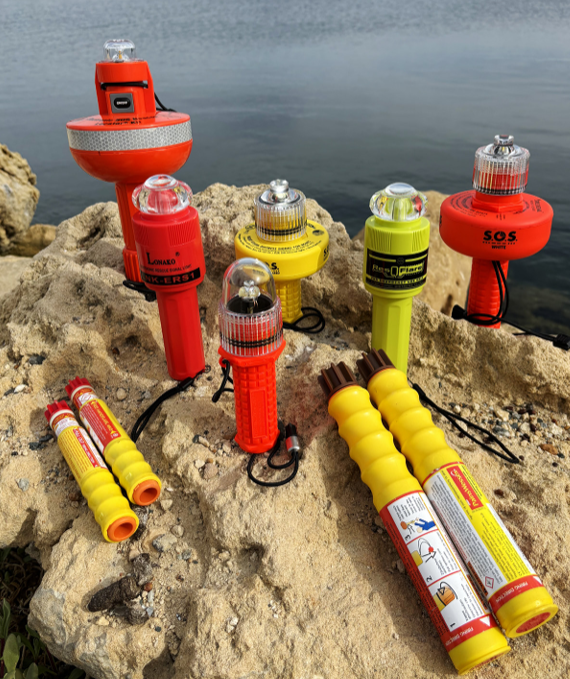
Electronic Visual Distress Signals (EVDS) are an electronic substitute for traditional pyrotechnic flares and a brilliant advance in marine safety. We are often asked how legal and effective they are and if they can be used instead of the traditional pyrotechnic flares.
Pros
- EVDS do not pose an explosive risk to your vessel
- EVDS will cot burn or injure the user
- Traditional flares fire to 300m and last 40 seconds so should only be used when there is a good possibility they will be seen by another vessel.
- EVDS last 6 – 20 hours depending on the brand and the function, therefore they can be left on for a long time, increasing the chance they may be seen.
- EVDS work by throwing out a vertical fan of red or green light that, when aimed at a target, will flash as the light passes from side to side of the target. The devices can shoot a signal light to an object up to about 30 kilometres away in clear conditions.
- Some EVDS flash a signal such as S.O.S which can not be confused if seen by a passing vessel.
- EVDS provide a long-lasting, reusable option for signalling. Once activated, they operate for at least six hours and can last even longer if you carry spare batteries in your safety kit.
- EVDS do not expire like pyrotechnics, simply replace the batteries annually.
- Far safer to have onboard, and safer to use.
- They are small enough to attach to lifejackets, onto a kayak or dinghy or even carried on a SUP and typically have enough power in the batteries to last for about five hours.
Cons
- As lights of this characteristic are not internationally approved distress signals there is a realistic chance that they may not be recognised as such and could therefore fail to effect an appropriate response in the event of a distress situation.
- There are also issues with some of these devices around the dispersion (directional beams) characteristics, range of the lights, and also the ability to differentiate the lights from a lit background (e.g. street lighting).
- There are issues still under experimentation to determining the best ergonomic qualities/capabilities.
- All of these issues require substantial testing prior to approval.
- For these devices to be effective distress signals they must be internationally recognised, which would require a change to Annex IV of the COLREGS.
Recreational vessels in most states can replace orange smoke and red hand flares provided a VHF radio and an EPIRB is board. For coastal waters, recreational vessels are still required to carry two parachute rocket flares in addition to your EVDS.
At this point to time carriage of pyrotechnic flares remains mandatory for AMSA Domestic Commercial Vessels and RAV’s. AMSA advises that no EVDS equipment currently available meets the light intensity requirements by the IMO Life Saving Appliance Code or AS 2092-2004, and Australian Standard AS 2092-2004. Therefore, they cannot be carried in substitute of pyrotechnic flares on vessels where mandatory carriage applies.
SOLAS
The SOLAS Convention prescribes the standards that distress equipment must meet and although it is not mandatory for small craft to comply with the Convention, adoption of similar Australian standards is consistent with the intent to align standards internationally. A variance from this practice in the eventual development of the respective Australian Standard may cause confusion in a distress situation. We are aware that the United States Coast Guard (USCG) has commissioned a research project titled Alternatives to Pyrotechnic Distress Signals on the development of standards for EVDS with the Radio Technical Commission for Maritime Services (RTCM). This research is investigating the effectiveness of EVDS with a view to supporting the development of international standards should these devices prove fit for use as a distress signalling means. This would result in subsequent international approval and inclusion in Annex IV of the COLREGS.
The USCG Project are also reviewing and analysing laboratory testing results to help identify what might be colour and patterns that provide the greatest conspicuousness. They are hoping to conduct field-testing to either confirm or improve-on the laboratory results in the July-August time frame. As well as the actual signal characteristic, USCG are also looking at the ergonomic qualities/ capabilities of whatever the device will look like. AMSA supports these two initiatives and keenly awaits its recommendations.

Our Recommendations
EVDS are a valuable asset to your safety kit. Replacing pyrotechnics with EVDS depends on how you use your boat and the regulations. If you have a recreational boat operating inshore waters then complete replacement is legal, safe, and recommended. If you have a recreational vessel operating coastally or offshore or if you have a commercial vessel then EVDS are a great asset, but we recommend you also carry your full Coastal or offshore Pyrotechnics.
From my maritime experience, I believe that EVDS are far safer, and more likely to be seen than Pyrotechnic flares. So, Next time you are ready to replace your inshore flares, or if you are preparing for an offshore passage, consider the EVDS option and the associated requirements. Remember it is illegal to carry out of date flares and you should always dispose of out-of-date flares correctly.
Discover more from SALUS MARITIME
Subscribe to get the latest posts sent to your email.
 SALUS MARITIME